 Learn Sheet Music
Learn to read sheet music by playing
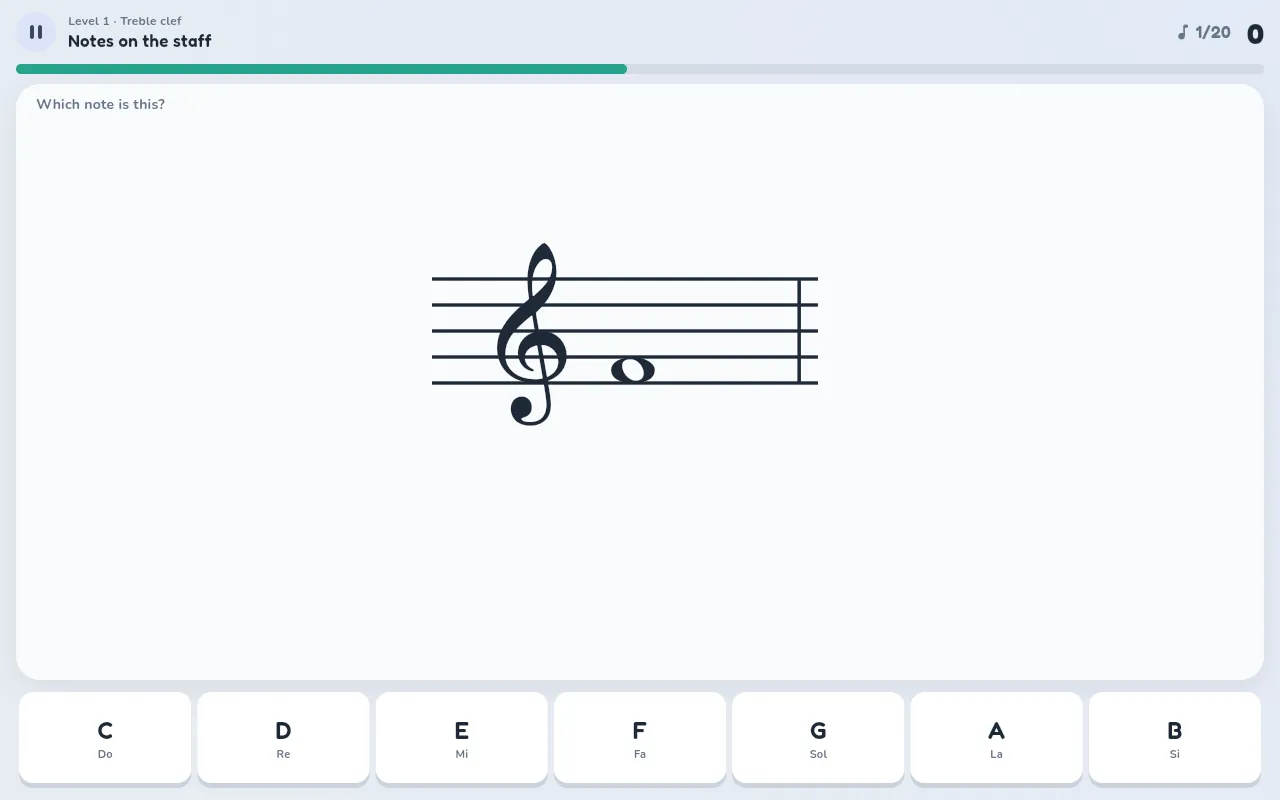
A note shows up on the staff and you have to name it before time runs out. Treble clef, bass clef, sharps, flats and chords, with on-screen buttons or your MIDI piano.
Free, no sign-up and no ads. Works on computers and phones.
What's inside
Everything you need to read music fluently
Treble and bass clef
Practice each clef on its own or both together, like in piano music, with ledger lines and middle C.
Sharps and flats
Accidentals come in little by little. On your phone you pick them with one tap, sliding over the key.
Connect your piano
Plug in a MIDI keyboard over USB and answer by playing the key. You can choose to make the octave count too.
Points for speed
The faster you answer, the more points you get. Streaks add up to 50% extra and every mistake costs you.
A tutorial for total beginners
Eleven short steps with an on-screen keyboard: the staff, middle C, the treble clef, the bass clef and ledger lines.
Sight-reading
Play tunes with a metronome: Twinkle, Twinkle, Frère Jacques, Ode to Joy. You score by playing the right note in time.
How to play
See the note, don't count lines
- A note appears. Just one, several at once or a chord, in treble clef, bass clef or both.
- Answer. With the buttons, with the letter keys on your keyboard (C D E F G A B) or by playing the key on your MIDI piano.
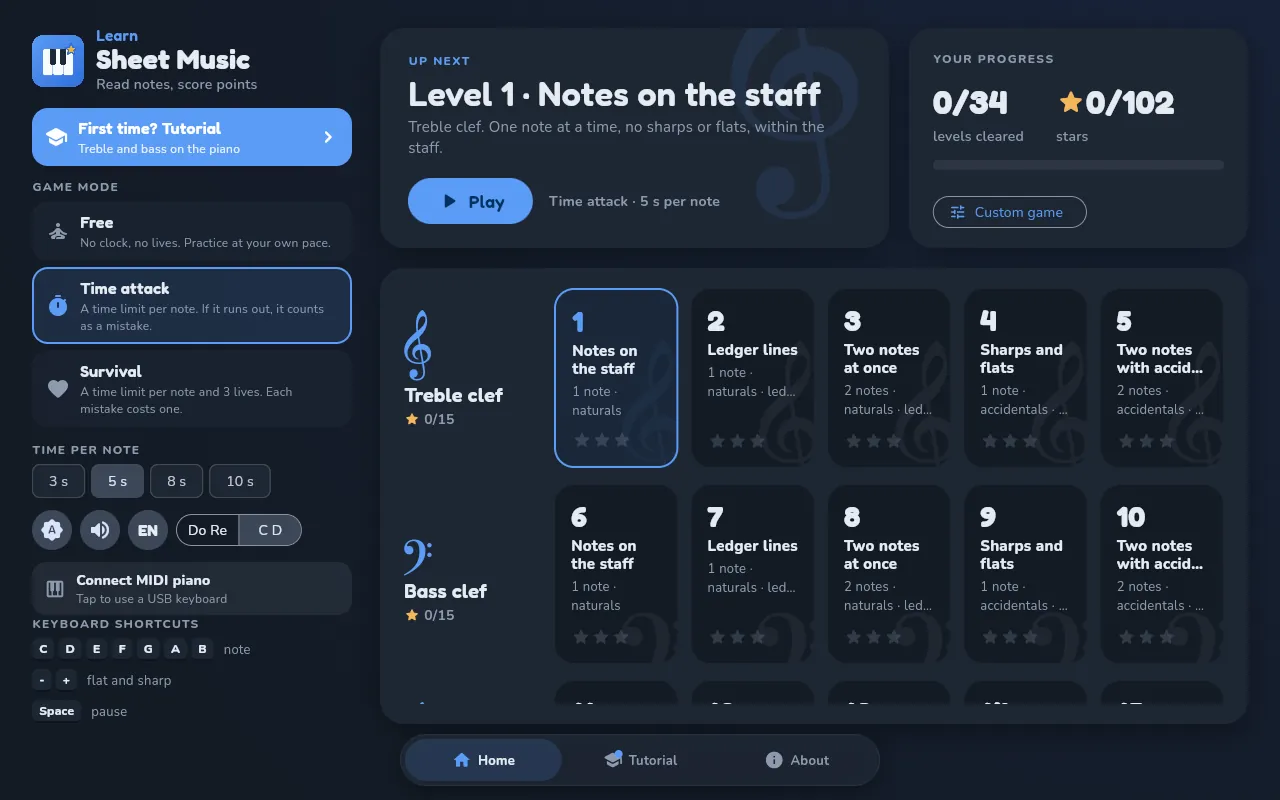
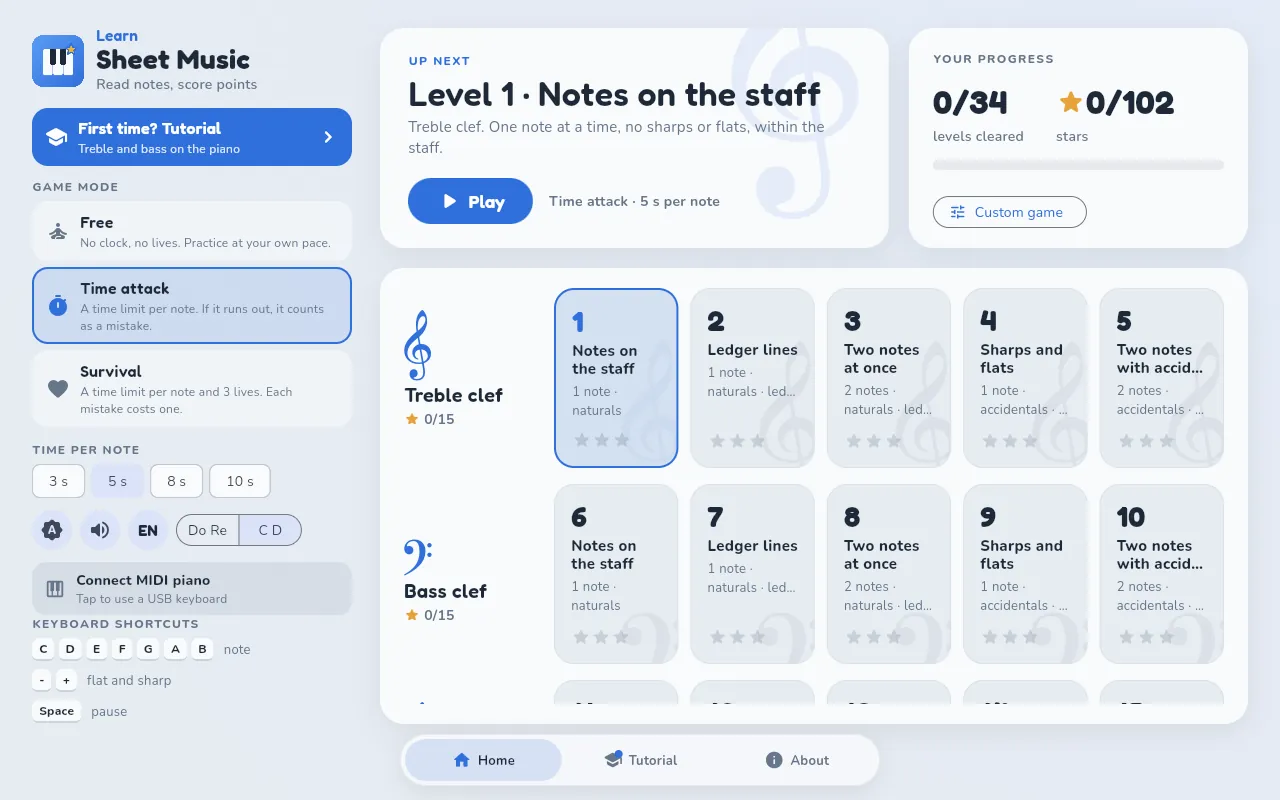
- Earn stars. You clear each level with 70% correct and get up to three stars. Your best scores are saved.
There are three modes: Free, with no clock; Time attack, with a time limit per note; and Survival, with three lives.
The path
54 levels, from one note to playing tunes
- Rhythm on the beat: quarters, rests, eighths, dotted notes, 3/4 and syncopation
- Treble clef: one note, ledger lines, two notes and accidentals
- Bass clef: the same steps
- Both clefs: single notes, several at once and chord with melody
- Chords: triads, diminished, augmented and seventh chords
- Rhythm: note value names, beats and equivalences
- Keys: key signatures and relative minors
- Sight-reading with a metronome
- Well-known tunes in treble and bass clef
- Major or minor? The key of a melody
- Reading and playing chords in both clefs
- Key signature notes, like in real sheet music
- Both hands: one note on each staff
And if you want something specific, Custom mode lets you pick the staff, number of notes, accidentals and chords.
Learn
Music theory guides
Short explanations, with examples on the staff, of the same things you practice in the game.
How to read sheet music
Notes in treble and bass clef, middle C and ledger lines.
Read the guide →Major and minor scales
Whole and half steps, the formula of each scale and where key signatures come from.
Read the guide →Music intervals
How to count them on the staff, major, minor and perfect, and a semitone table.
Read the guide →Chords on the staff
Thirds, major and minor triads, diminished, augmented and seventh chords.
Read the guide →Note values and rests
Whole, half, quarter, eighth and sixteenth notes, rests, dots and equivalences.
Read the guide →The circle of fifths and key signatures
How to tell the key from the key signature and find the relative minor.
Read the guide →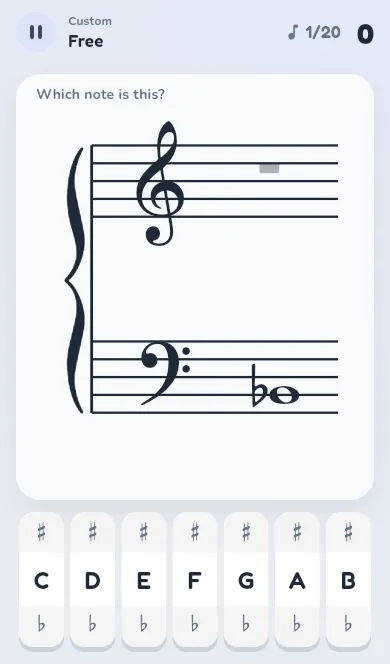
On any screen
On your computer, tablet or phone
It opens in the browser, nothing to install. On your phone you can play in portrait or landscape, in light or dark mode. If you like, add it to your home screen and it works like an app.
You can also play with your computer keyboard: the letters C D E F G A B name the note, - is flat and + is sharp.
Frequently asked questions
Is it free?
Yes. It runs in your browser, with no sign-up and no ads. If you find it useful, you can buy me a coffee to support the project.
Do I need a piano?
No. You can answer with the on-screen buttons or your computer keyboard. If you have a MIDI piano or keyboard, plug it in over USB and answer by playing.
Which browsers can connect a MIDI piano?
Chrome, Edge or Opera on a computer, which support Web MIDI. Safari and iPhone browsers don't allow it yet; there you play with the buttons.
Does it work if I have never read music?
Yes. A short tutorial explains the staff, middle C and the treble and bass clefs with an on-screen keyboard, and the levels start with a single note in treble clef. You can also read how to read sheet music before you play.
Does it work on my phone?
Yes, in portrait and landscape. Sharps and flats are picked with one tap on each key.
Is my progress saved?
Yes. Stars, best scores and your settings are saved on your device, no account needed.